
Chain Conveyor
Chain Conveyor - Handling heavy, hot, and abrasive materials with unmatched power and durability
Designed and manufactured by Kian Industry | Technical cooperation with Ceylan Makina | Suitable for cement, steel, mining

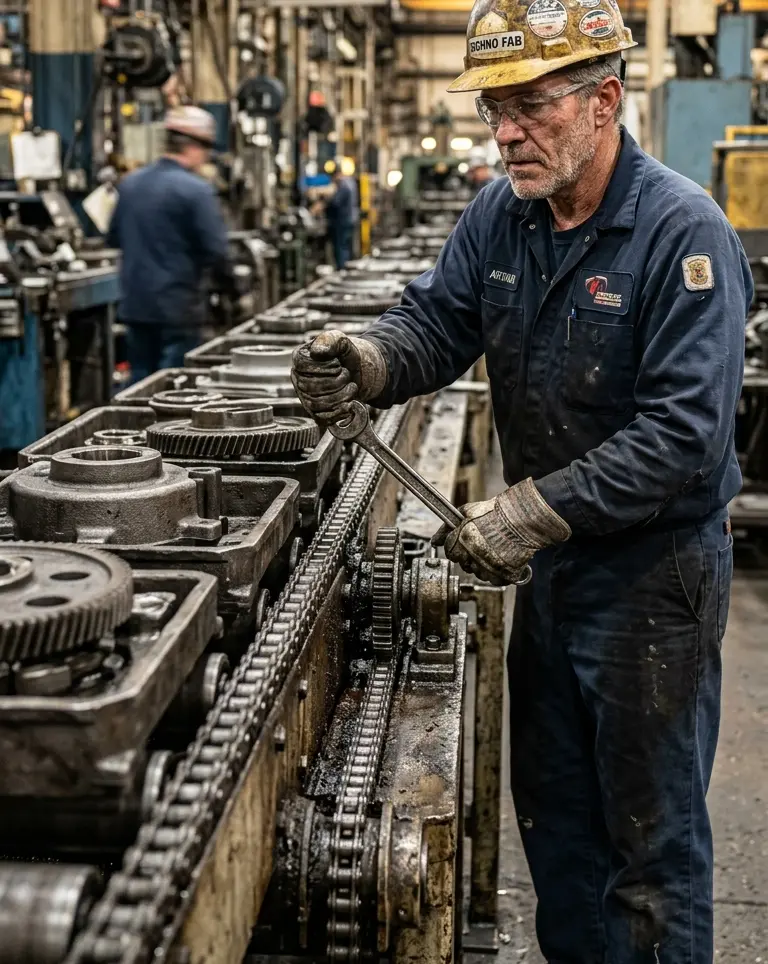
Industrial Chain Conveyor in operation - handling materials with temperatures up to 400°C
The chain conveyor is the strongest and most durable option for conveying heavy, hot (up to 400°C), abrasive, and coarse-grained bulk materials. Unlike belt conveyors, alloy steel chains are completely resistant to cutting, heat, and oil. Kian Industry, using standard European chains and custom design based on your needs, guarantees the highest efficiency and service life.
Chain Conveyor Technical Specifications
| Feature | Range & Description |
|---|---|
| Conveying Capacity | 10 to 1000 tons/hour |
| Path Length per Unit | Up to 100 meters horizontal and up to 50 meters inclined (max 45°) |
| Material Temperature Range | From -30 to +400°C |
| Chain and Flight Material | 16MnCr5 alloy steel, Manganese steel, Stainless Steel 304 and 316 for food and chemical applications |
| Chain Speed | 0.1 to 0.8 m/s (adjustable with inverter) |
| Trough Width | 200 to 1600 mm |
| Motor Power | 2.2 to 200 kW |
What is a Chain Conveyor and How Does It Work?
A chain conveyor is a device that uses one or two steel chains with flights to convey bulk materials inside a metal trough or tube. The gearmotor drives the chain through a special sprocket. Material enters the trough from the inlet hopper, and the flights push it along the entire path to the discharge point. Unlike belt conveyors, which are sensitive to cutting and heat, steel chains are completely resistant to sharp, hot, and oily materials. This equipment is ideal for very heavy materials such as iron ore, cement clinker, coke, slag, and even municipal waste. At Kian Industry, depending on the material type and environmental conditions, chains and flights are manufactured with special alloys and precise heat treatment to provide maximum wear and impact resistance. Additionally, the trough bottom is lined with high-chrome cast iron or ceramic wear plates to reduce friction and extend component life.
The chain tensioning system at the end of the device allows precise adjustment of chain slack. Safety sensors such as chain break sensors and displacement sensors are installed as standard on Kian Industry models to immediately stop the machine in case of any issue. All these features have made the chain conveyor the backbone of material handling lines in heavy industries.
History of Chain Conveyor Manufacturing and Its Origins
The first chain conveyors were built in the 1920s in coal mines in Germany and England. Before that, mines used rail cars and horses to transport coal, which was very slow, costly, and intermittent. Early belt conveyors had weak fabric and rubber belts that tore quickly against sharp rocks and could not handle hot materials. Mining engineers sought a solution that was continuous, could operate on steep slopes, and had high resistance to wear and heat. The solution was the use of steel chains with steel flights. In 1925, the first successful chain conveyor with a capacity of 50 tons/hour and a length of 200 meters was installed in the Ruhr mine in Germany. In the 1930s, this technology entered the steel, cement, and coal-fired power plant industries. In the 1950s, alloy chains with advanced heat treatment were developed, doubling service life. Today, the chain conveyor has become the gold standard for handling difficult materials in heavy industries. Kian Industry, in cooperation with Ceylan Makina, follows these advanced standards and delivers equipment with a service life of over 15 years in harsh operating conditions.
Applications of Chain Conveyors in Various Industries and Competitive Advantages
Cement Industry: Conveying hot clinker from the kiln to the cement mill, conveying gypsum, limestone, and clay. Materials with temperatures of 150 to 350°C are directly loaded onto the chain conveyor.
Steel Industry: Conveying coke, iron ore, pellets, slag, and steel scrap with temperatures up to 400°C and high densities up to 3 t/m³.
Mining Industry: Conveying coal, copper, zinc, lead, salt, and minerals with particle sizes up to 300 mm.
Chemical and Petrochemical Industries: Conveying abrasive chemical powders, activated carbon, catalysts, and granular urea.
Recycling Industry: Conveying plastic waste, paper, cardboard, shredded rubber, and municipal waste. Sharp materials like glass shards and metal parts are easily handled.
Coal-Fired Power Plants: Conveying raw coal from the stockpile to the boiler and conveying ash from the bottom of the boiler.
Key Advantages Over Other Conveyors: Heat resistance up to 400°C, ability to handle abrasive and sharp materials without rapid wear, ability to handle oily and greasy materials without slipping, very long service life (over 15 years), capacity up to 1000 tons/hour, path length up to 100 meters without intermediate stations, slope capability up to 45° without slipping, and simple maintenance with readily available spare parts. Kian Industry offers all these advantages with a 24-month warranty and 10-year support.
In modern production lines, the chain conveyor is an economical and intelligent choice due to its high reliability and low maintenance cost. Kian Industry engineers, based on your material type, temperature, particle size, and plant layout, design and deliver the best model (separate flight, solid plate, tubular, flexible, or stainless steel).
More technical details: Capacity calculation formula (Q = width × flight height × speed × density × fill factor × 3600), chain pitch and material selection based on DIN 8167 standard, common troubleshooting methods (chain jump, rattling noise, capacity reduction, motor overheating, dust leakage), daily, monthly, and annual maintenance checklists, ATEX standards for hazardous areas, and new innovations such as self-lubricating chains, ceramic-lined trough bottoms, and intelligent wear monitoring systems. All these aspects are incorporated into Kian Industry's design and manufacturing to ensure you have the best experience.
🔧 Chain Capacity Calculator
⚡ Motor Power & Chain Tension
⏱️ Life & Maintenance Cost Estimator
⚙️ Chain Wear Prediction & Replacement Schedule
📅 Recommended Replacement: 0 months from now
📋 8 Reasons to Choose Chain Conveyor Over Other Options
- High Temperature Tolerance: Up to 400°C, suitable for cement clinker and steel coke
- Wear Resistance: Hardened alloy chains last 3 times longer than belts
- Ability to Handle Sharp Materials: Glass shards, metal scrap, ore without damaging the equipment
- Very High Capacity: Up to 1000 tons/hour for large production lines
- Long Path Length: Up to 100 meters without intermediate stations and efficiency loss
- Excellent Slope Capability: Angles up to 45° without slipping, unlike belt conveyors
- Operation in Dusty and Humid Environments: No slipping and no electrical failure
- Low Lifetime Maintenance Cost: Chain replacement every 3-5 years, compared to belt replacement every 6 months in harsh conditions


