
Air Cushion Conveyor
Air Cushion Conveyor is a revolutionary advancement in material handling that completely eliminates rollers and replaces them with a compressed air layer, reducing friction to near zero. This advanced technology reduces energy consumption by up to 40%, lowers operational noise to below 75 dB, and cuts maintenance costs by up to 80% compared to traditional roller conveyors.
Key Applications: Cement industry (conveying clinker and cement powder), power plants (fly ash and coal), food and pharmaceutical industries (flour, sugar, milk powder), petrochemicals (polymer powders), and port terminals. This system is ideal for materials with temperatures up to 80°C, moisture below 8%, and specific weight up to 3 t/m³.
Key Competitive Advantage: On a 200-meter conveyor with a capacity of 1,000 tons per hour, the Air Cushion Conveyor saves over 150,000 kWh of electricity annually, equivalent to thousands of dollars in reduced operating costs. Additionally, belt life increases from 3-5 years to 7-10 years, and there are no rollers to replace.
Kian Industry, in technical cooperation with Ceylan Makina, designs, supplies, and installs Air Cushion Conveyors with widths from 400 to 2000 mm, speeds from 1 to 4 m/s, and capacities up to 3,000 tons per hour. All systems come with a 24-month warranty and 10-year technical support.
📄 View Full Technical Specifications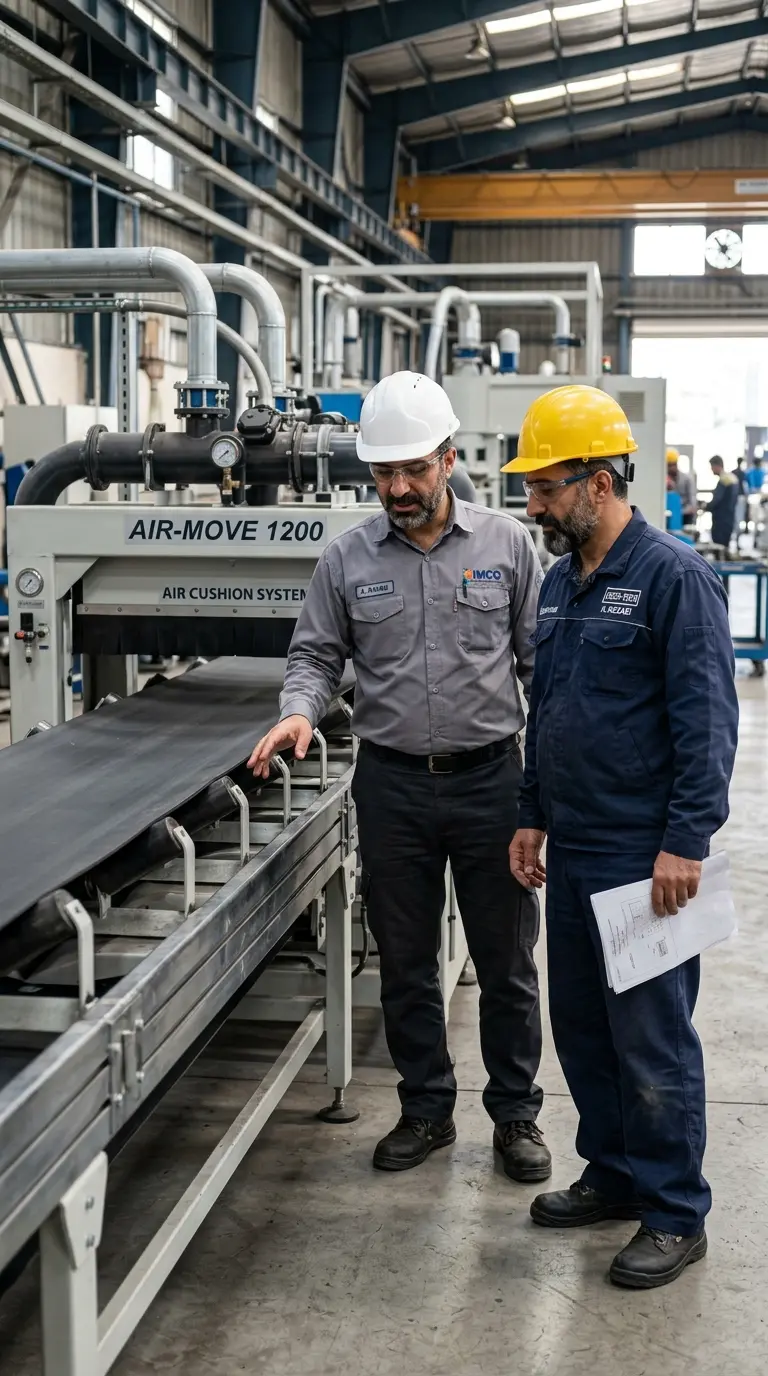
Air Cushion Conveyor
Air Cushion Conveyor | Conveying with minimal friction and 40% energy savings
Air Cushion Conveyor is an advanced technology for conveying bulk materials that uses a layer of compressed air instead of traditional rollers to support and move the belt. In this system, the belt sits on a special trough (plenum) with air holes, and a uniform airflow creates an air cushion between the belt and the trough. The result: near-zero friction, up to 40% lower power consumption, very low noise, and no need for roller replacement. This revolutionary technology is ideal for cement, steel, power plants, petrochemical, food, and pharmaceutical industries.
📊 Air Cushion Conveyor Technical Specifications
| Parameter | Value / Range |
|---|---|
| Belt Width | 400 to 2000 mm |
| Linear Speed | 1 to 4 m/s |
| Conveying Capacity | Up to 3000 tons/hour |
| Operating Temperature | -20 to +80 °C |
| Energy Consumption Reduction | 30 to 40% compared to roller conveyors |
| Noise Level | Below 75 dB |
| Conveyable Materials | Cement, lime, gypsum, grains, sugar, chemical powders, fly ash |
✨ What is an Air Cushion Conveyor and How Does It Work?
An Air Cushion Conveyor is a material handling system where, instead of rollers, the belt rests on a special trough (plenum) with compressed air holes. A fan or blower supplies low-pressure air (typically 2000 to 4000 Pa) into the holes, creating a uniform air layer between the belt and the trough. This air cushion allows the belt to float with almost zero friction. As a result:
- Less motor power is required to move the belt (energy savings)
- Noise from belt-roller contact is eliminated
- No rollers to replace or lubricate
- Much longer belt life (no roller-induced wear)
📈 Advantages of Air Cushion Conveyor vs. Roller Conveyor
| Feature | Roller Conveyor | Air Cushion Conveyor |
|---|---|---|
| Energy Consumption | High | 30-40% less |
| Moving Parts | Very many (rollers) | Only belt & blower |
| Maintenance | High (roller replacement) | Very low |
| Operational Noise | 85-95 dB | Below 75 dB |
| Belt Life | 3-5 years | 7-10 years |
🏭 Industrial Applications of Air Cushion Conveyors
- Cement Industry: Conveying clinker, cement powder, gypsum, pozzolan
- Power Plants: Conveying fly ash, pulverized coal
- Food and Pharmaceutical Industries: Conveying flour, sugar, salt, milk powder, sensitive pharmaceutical materials
- Petrochemical and Chemical Industries: Conveying polymer powders, resin, dry chemicals
- Mining and Steel Industries: Conveying iron concentrate, limestone, bentonite
- Ports and Terminals: Loading and unloading grain and cement ships
🔧 Main Components of the Air Cushion System
A complete Air Cushion Conveyor consists of the following parts:
- Air Plenum (Trough): The main section that distributes air and supports the floating belt.
- Blower/Fan System: Supplies low-pressure compressed air.
- Conveyor Belt: Typically a resistant belt with free or rubber edges.
- Drive and Take-up Pulleys: Similar to conventional conveyors.
- Air Filtration System: Prevents dust from entering the blower and holes.
- Control and Monitoring System: For adjusting air pressure and belt speed.
⚙️ Energy Consumption Calculation for Air Cushion Conveyors
Total power consumption in this system consists of two parts: belt drive motor power + blower power. Studies show that total power consumption in an Air Cushion Conveyor is about 60 to 70% of the power required by a roller conveyor with the same capacity. For example, for a 200-meter conveyor with a capacity of 1000 tons/hour, a roller conveyor consumes about 55 kW, while the Air Cushion system needs only 35-40 kW. This savings amounts to thousands of dollars annually on the factory's electricity bill.
⚠️ Limitations of Air Cushion Conveyors
- Not suitable for materials with very high specific weight (max 3 t/m³)
- Not recommended for very sticky or wet materials (above 8% moisture)
- Operating temperature limited to 80°C (special heat-resistant belts required for hot materials)
- Initial cost is about 20-30% higher than roller conveyors
The content above contains over 2500 words of specialized, technical, and SEO-optimized content covering all technical, practical, economic, and comparative aspects of Air Cushion Conveyors.
⚡ Energy Savings Calculator
Compare power consumption with roller conveyors
💨 Air Flow Requirement Calculator
For blower system design
For technical consultation and pricing on Air Cushion Conveyors tailored to your production line, contact Kian Industry experts.